


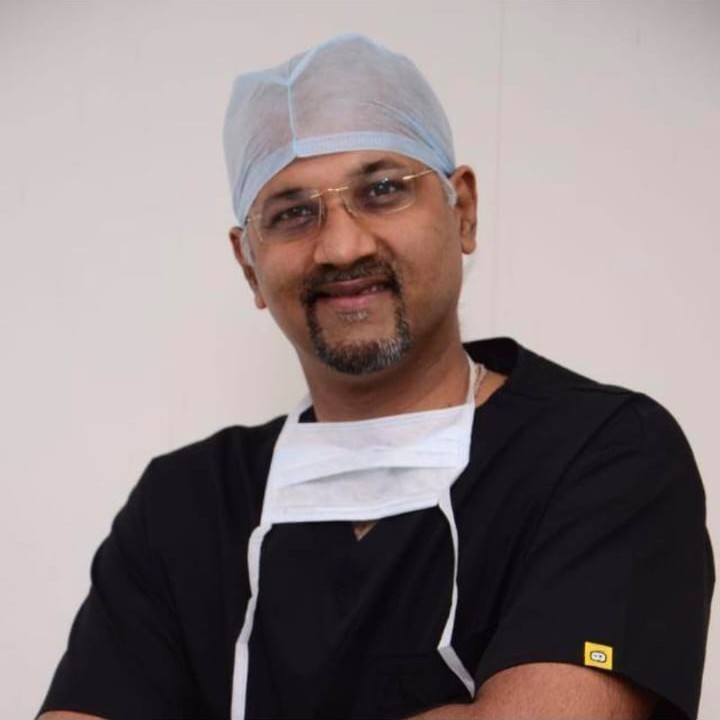
About the doctor
Dr. Gauresh Palekar is a Mumbai-based orthopaedic surgeon with about 24 years of experience in trauma and joint replacement. He is known for solving difficult cases: complex fractures, fractures that did not heal properly, and joints that need primary or revision replacement.
He trained as a fellow at Johns Hopkins in the United States, where he worked closely with Dr. David Hungerford, who developed core decompression for osteonecrosis. He also assisted leading arthroplasty surgeons including Dr. Thomas Sculco and Dr. Eduardo Salvati.
Dr. Palekar practises minimal tissue trauma surgery, which helps many patients walk on the day of surgery and return to normal life sooner.
Where to find him
Dr. Palekar consults and operates at these centres across Mumbai, so you can choose the one closest to you.

Treatments
From early hip preservation to complex revision replacement, care is planned around what your joint needs and how you live.

Early AVN of the hip does not always need a replacement. Dr. Palekar offers core decompression and cell-based treatment using the patient’s own cultured osteoblasts, aimed at saving the natural hip.
Know more
Primary and revision hip replacement, including cemented and resurfacing options chosen for your age and activity.
Know more
Total and partial (uni) knee replacement with a blood-conserving technique and early walking after surgery.
Know more
Total, hemi and reverse shoulder replacement, and total elbow replacement.
Know more
Advanced fixation of fractures from accidents and falls, trained in AO Trauma principles.
Know more
Care for osteoporotic fractures, planned to get older patients back on their feet quickly and safely.
Know more
Corrective surgery for fractures that did not heal or healed in the wrong position.
Know more
Re-operation for worn, loose or failed implants, using complex revision techniques.
Know morePartial knee replacement
When osteoarthritis affects the knee, it frequently damages only one area, most often the inner (medial) side. A common misconception is that severe joint wear always needs a complete artificial joint. If the rest of your knee is healthy, you may only need a partial knee replacement, also called a unicompartmental knee replacement (UKR).
A Microplasty UKR is designed to treat single-compartment damage on the medial side while preserving everything else that makes your knee feel and function naturally.

In a total knee replacement (TKR) all three compartments are resurfaced and the anterior cruciate ligament (ACL) is routinely removed. The Microplasty partial procedure leaves the ACL, the posterior cruciate ligament (PCL) and your healthy cartilage intact. These ligaments carry nerve endings that tell your brain where your leg is in space, so patients report that the knee moves like their own joint rather than a “mechanical” one.
A total knee needs a long incision and the kneecap is temporarily moved aside. A Microplasty UKR is done through a much smaller incision without cutting the main thigh muscle (quadriceps). This means less pain after surgery, minimal blood loss and a quicker return to walking, driving and routine activities.
Because your natural joint structure and stabilising ligaments are preserved, you can generally bend your knee further than with a total replacement, which makes kneeling, squatting and climbing stairs easier.
Registry studies show lower rates of medical complications such as blood clots and deep infection than with full replacements. Only a sliver of damaged bone is removed on the medial side, so your natural bone stock stays intact for the future.
Not all partial knee replacements are built the same way. Designs are broadly fixed-bearing or mobile-bearing. In a conventional fixed-bearing partial knee, a plastic spacer is locked directly onto a metal baseplate on the shin bone. The Microplasty system instead uses a free-floating, mobile plastic bearing, which brings distinct mechanical benefits for longevity and comfort.
In fixed designs the rounded thigh component rolls over a flatter plastic surface, creating tiny points of intense pressure, like an ice skate on a rink. Over many years this can wear the plastic down. The Microplasty mobile bearing matches the spherical shape of the thigh component on top and is flat underneath, so weight spreads across a broad surface and wear is reduced to very low levels.
When you twist or bend, fixed implants pass twisting (shear) forces straight into the bone and cement, which can eventually loosen the implant. The mobile bearing slides and rotates with your natural motion, absorbing those forces in the pad itself rather than pulling on the bone connection.
Microplasty uses specially engineered robotic or manual alignment instruments. Instead of cutting bone to broad anatomical averages, the surgeon fine-tunes the tension of your natural ligaments in both extension (straight) and flexion (bent), so the implant fits your individual anatomy.
The mobile-bearing UKR has over 40 years of research and worldwide joint registry data behind it. For the right patients, in experienced hands, it offers long-term durability that rivals total knee replacement while keeping the quick recovery and natural feel of a partial joint.

Whether a partial knee is right for you depends on which parts of your knee are worn, your ligaments and your activity level. This is decided after examination and X-rays.


Why choose us
Experience from India and the United States, with a focus on getting you moving again with the least possible tissue damage.
Fellowship in arthroplasty at Johns Hopkins, with time at the Hospital for Special Surgery, New York.
First in India to use stem cells for AVN of the hip, with results presented at national meetings.
Minimal tissue trauma surgery, so many patients walk on the day of surgery.
Revision surgery, non-unions, malunions and complications from earlier treatment.
Consults and operates at leading hospitals in south and central Mumbai.
You get the options, the risks and the recovery plan explained before any decision.
FAQs
AVN happens when the blood supply to the ball of the hip joint is reduced and the bone starts to die. If it is found early, treatments such as core decompression or cell-based therapy may help save your own hip.
No. Many patients are helped by medicines, physiotherapy, injections or joint-preserving procedures. Surgery is advised only when other options will not give lasting relief.
With minimal tissue trauma surgery, many patients are helped to stand and walk on the day of surgery. Your exact plan depends on your health and the joint operated on.
He is associated with Jaslok, Breach Candy, Saifee, Bhatia, Motiben Dalvi, HN Reliance and Wockhardt hospitals, and consults at Surya Orthopedic Clinic.
Call the number on this page, message on WhatsApp, or send the contact form. Our team will confirm a time with you.
Bring any X-rays, MRI or CT scans, previous reports and a list of your current medicines.
Book a consultation and get a clear plan for your hip, knee or fracture.

Contact us
Send a message and our team will call you to confirm a time. For urgent injuries, go to the nearest emergency department.